
A kitchen can have plenty of cabinets and still feel short on storage.
The problem is often not the total amount of space available. It is how that space is divided, accessed and used. Deep cupboards hide everyday items, oversized drawers allow utensils to become mixed together, and benchtops gradually fill with appliances that have no convenient home.
Well-chosen kitchen organisers can turn these frustrating areas into practical storage without requiring a complete renovation. By matching each organiser to a specific problem, Australian homeowners can create a kitchen that is easier to cook in and more comfortable to use every day.
What Is the Best Way to Organise a Kitchen?
The best way to organise a kitchen is to store items according to where and how often they are used.
Everyday cutlery belongs near the main food-preparation area. Saucepans and cooking utensils should sit close to the cooktop. Plates and glasses should be accessible from the dishwasher, while food containers should be kept near the space where leftovers and lunches are prepared.
This method works better than organising by size or appearance because it supports the household’s normal routine.
Before buying any storage product, ask three questions:
-
What is difficult to find?
-
Which area becomes untidy most quickly?
-
What do I regularly move to reach something else?
The answers will show where an organiser can make the greatest difference.
1. Empty and Measure Before You Organise
The most common kitchen organisation mistake is buying storage products before measuring the space.
External cabinet measurements do not always reflect usable internal space, because runners, hinges, pipes and door frames reduce the available area. Measure the internal width, depth and height, plus the door opening and any clearance around hinges or plumbing.
Measure the items being stored, too. A drawer insert may fit the drawer perfectly but still be unsuitable if its compartments are too short for your cooking utensils.
Once everything is out, check for broken tools, expired food, duplicate utensils and containers without matching lids. Organising fewer useful items is easier than creating space for possessions the household no longer needs.
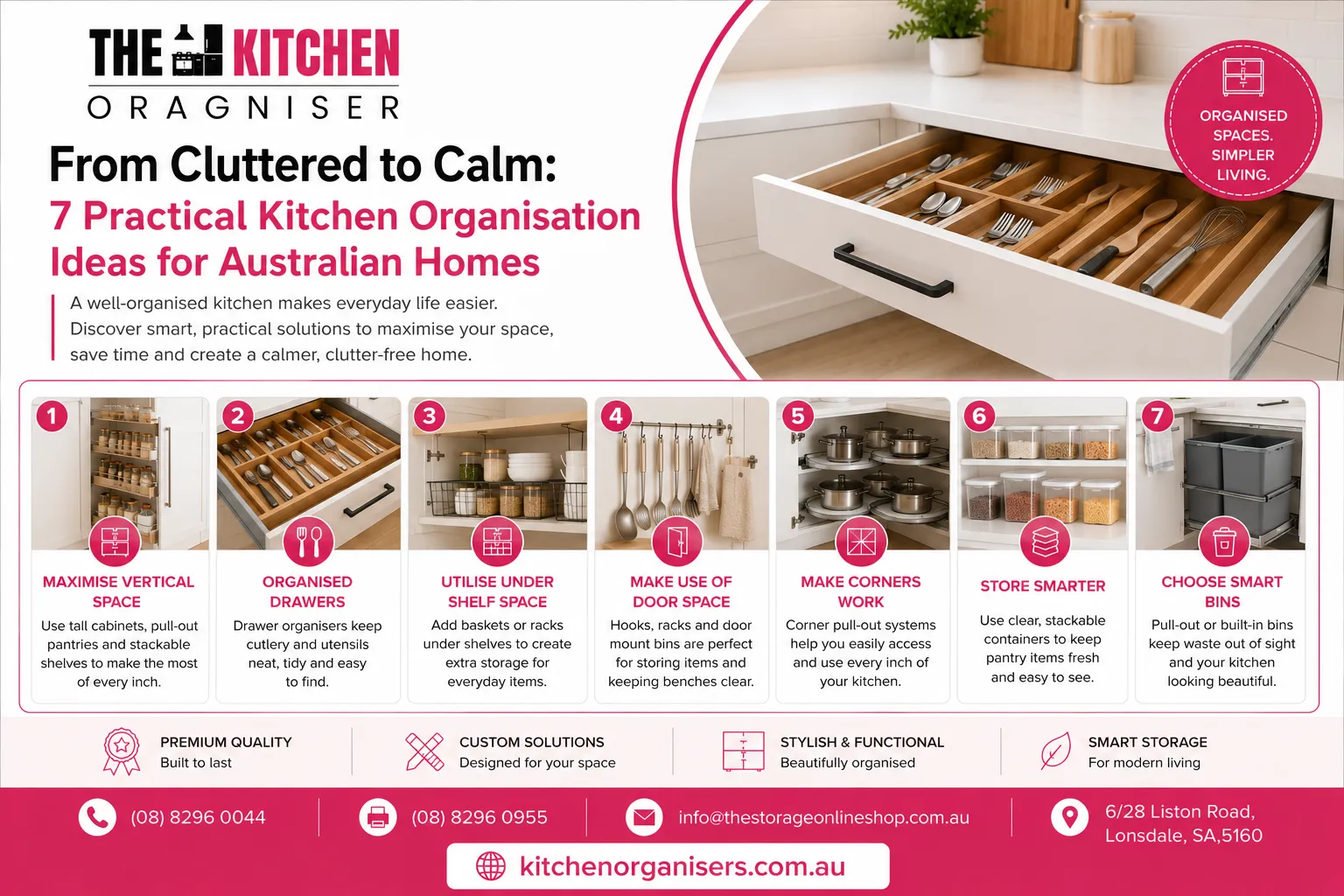
2. Create a More Functional Cutlery Drawer
The cutlery drawer is opened several times a day, which makes it an ideal place to begin.
A suitable kitchen drawer organiser gives forks, knives, spoons and smaller tools a defined position. This stops them sliding into one another and makes it easier for everyone in the household to return items to the right place.
Choose based on the drawer’s contents rather than the first standard tray you find:
-
Narrow compartments work well for cutlery.
-
Longer sections suit spatulas, tongs and serving spoons.
-
Adjustable dividers accommodate utensils of different sizes.
-
Two-level inserts provide extra storage in deep drawers.
Keep frequently used items in the easiest-to-reach sections. Tools used only for baking or entertaining can go in a separate drawer. The aim is not to fill every centimetre — leaving a little open space makes the drawer easier to maintain.
3. Give Cooking Utensils Their Own System
Large utensils often become mixed together because they do not fit neatly into a standard cutlery tray.
Separate them into practical groups: stirring and serving, food preparation, baking, grilling, measuring. Store daily-use tools close to the cooktop or main preparation bench, and place less frequently used items further away.
A divided drawer is generally more practical than a crowded utensil container on the benchtop. It keeps tools protected from cooking splashes and preserves clear working space. That said, a small countertop holder may still suit the three or four utensils used during most meals.
4. Use Cupboard Height More Effectively
Kitchen cupboards often waste the space above plates, bowls and pantry goods. When shelves sit too far apart, homeowners create unstable stacks or leave the upper section unused entirely.
A kitchen cupboard organiser such as a shelf riser can create an additional storage level without altering the cabinetry. Shelf risers work well for dinner plates, mugs, food containers, tins and jars, and tea and coffee supplies.
Avoid stacking heavy items on a lightweight organiser — check its dimensions and intended use before placing cookware on it. Keep frequently used items at a comfortable height and reserve high shelves for lightweight or occasional products.
5. Store Trays, Boards and Lids Vertically
Flat items are usually stacked horizontally. This looks tidy immediately after organising, but becomes inconvenient the moment the item at the bottom is needed.
Vertical dividers let baking trays, chopping boards, pot lids and serving boards stand upright, so each can be removed without lifting the rest of the stack.
This works particularly well in narrow cupboards and spaces above ovens or refrigerators. Arrange items by size, keeping heavier pieces where they are supported securely.
6. Improve Access to Deep Cupboards
A deep cupboard offers plenty of storage, but much of it becomes impractical when products disappear behind one another.
Pull-out baskets, sliding shelves and removable tubs bring the contents forward. These are especially useful in lower cabinets, where reaching the back otherwise means bending and moving several items.
Organise deep cupboards by category — breakfast supplies, baking ingredients, snacks, sauces, containers, small appliances. Place heavier items lower and keep frequently used products near the front. Clearly labelled removable tubs suit renters well, since they don’t require permanent cabinet changes.
7. Keep the Benchtop for Daily Essentials
Clear benchtops make a kitchen feel calmer and leave more room for food preparation.
This doesn’t mean hiding every appliance. A kettle or coffee machine used daily may deserve a permanent position. Anything used weekly or less can usually live in a cupboard or pantry.
A useful rule:
-
Daily use: keep accessible.
-
Weekly use: store nearby.
-
Occasional use: move to secondary storage.
Avoid crowding the bench with decorative baskets. An organiser should reduce visual clutter, not become another object to move and clean.
Organisation Should Match Real Life
A beautiful storage system isn’t successful if it’s difficult to maintain.
Consider how other household members actually use the kitchen. Children may need lunch containers on a lower shelf. Tea and coffee supplies should sit close to the kettle. A household that cooks often needs more accessible spice and cookware storage than one preparing simpler meals.
After reorganising an area, use it normally for a week or two. Notice whether items get returned to their assigned positions. When they repeatedly end up somewhere else, the location is probably inconvenient.
Adjusting the system isn’t a failure. It’s part of creating an arrangement that works in everyday life.
Frequently Asked Questions
What are kitchen organisers?
Kitchen organisers are accessories or fitted storage systems that improve how items are arranged and accessed inside drawers, cupboards and pantries. Examples include drawer inserts, dividers, shelf risers, pull-out baskets and vertical racks.
What does a kitchen drawer organiser do?
It divides the drawer into sections for cutlery, utensils or cooking tools, preventing smaller items from becoming mixed together and making the contents easier to find.
Is a kitchen cupboard organiser worth buying?
It’s worthwhile when it solves a clear storage problem. Shelf risers use empty vertical space, while pull-out systems improve access to deep cabinets.
How do I measure for a drawer organiser?
Measure the internal width, depth and height. Check for curved sides, runners and overhead clearance, then compare these with the organiser’s full dimensions before purchasing.
Are kitchen organisers useful for renters?
Yes. Freestanding shelf inserts, adjustable drawer dividers and removable baskets improve storage without permanent installation. Check your lease conditions before drilling or attaching anything to cabinetry.
Final Thoughts
A more organised kitchen doesn’t begin with buying a large collection of storage products. It begins with identifying the areas that interrupt everyday cooking and choosing practical solutions for those specific problems.
Start with one troublesome drawer or cupboard. Remove what’s no longer needed, measure the space and introduce an organiser that makes the contents easier to see and reach.
The best-organised kitchen isn’t the most perfect-looking one. It’s the kitchen where everything useful has a sensible place.